


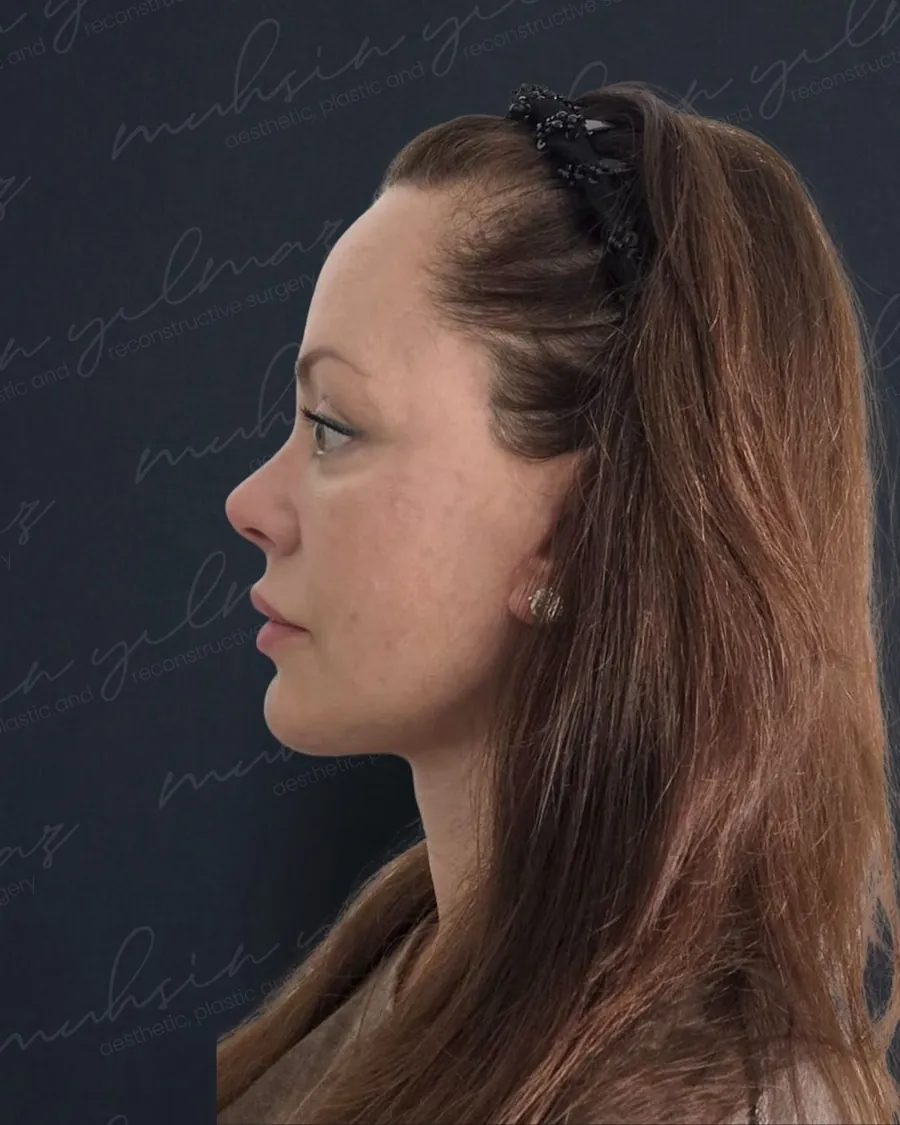
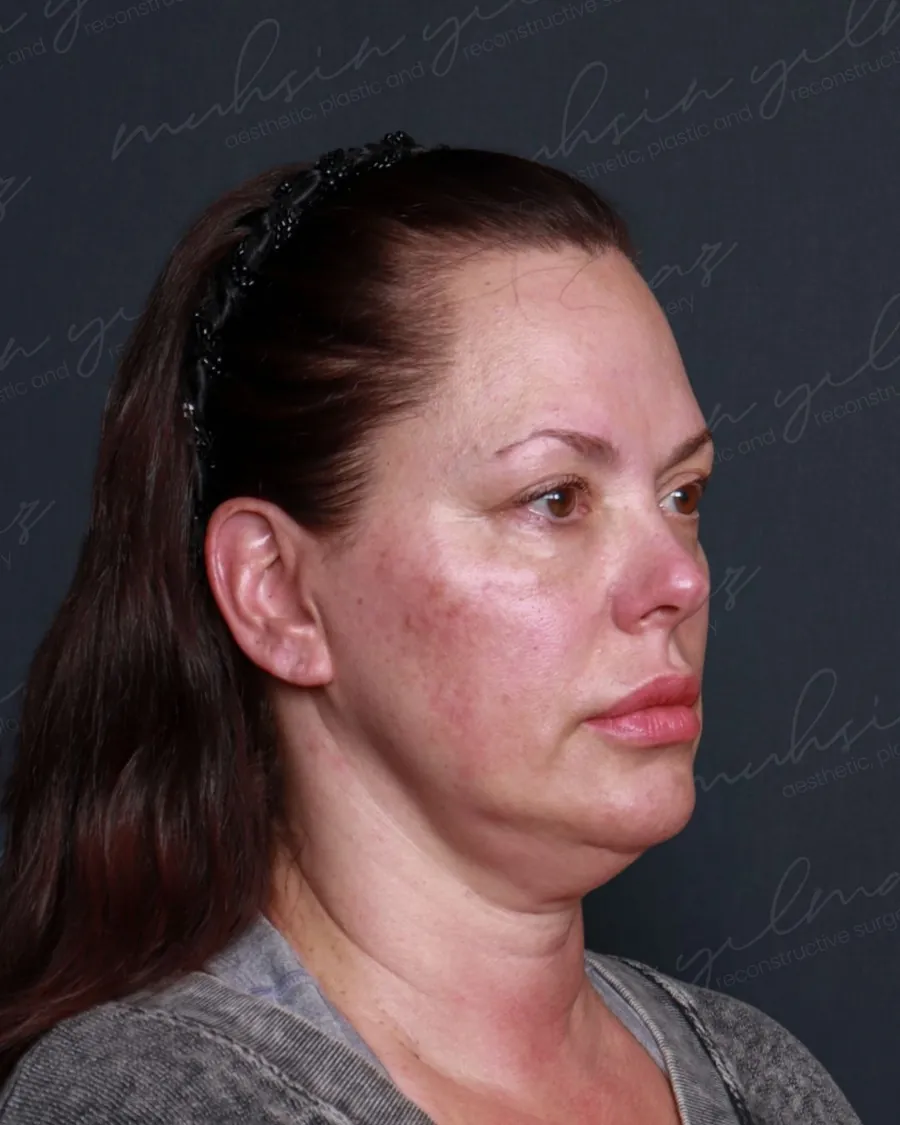
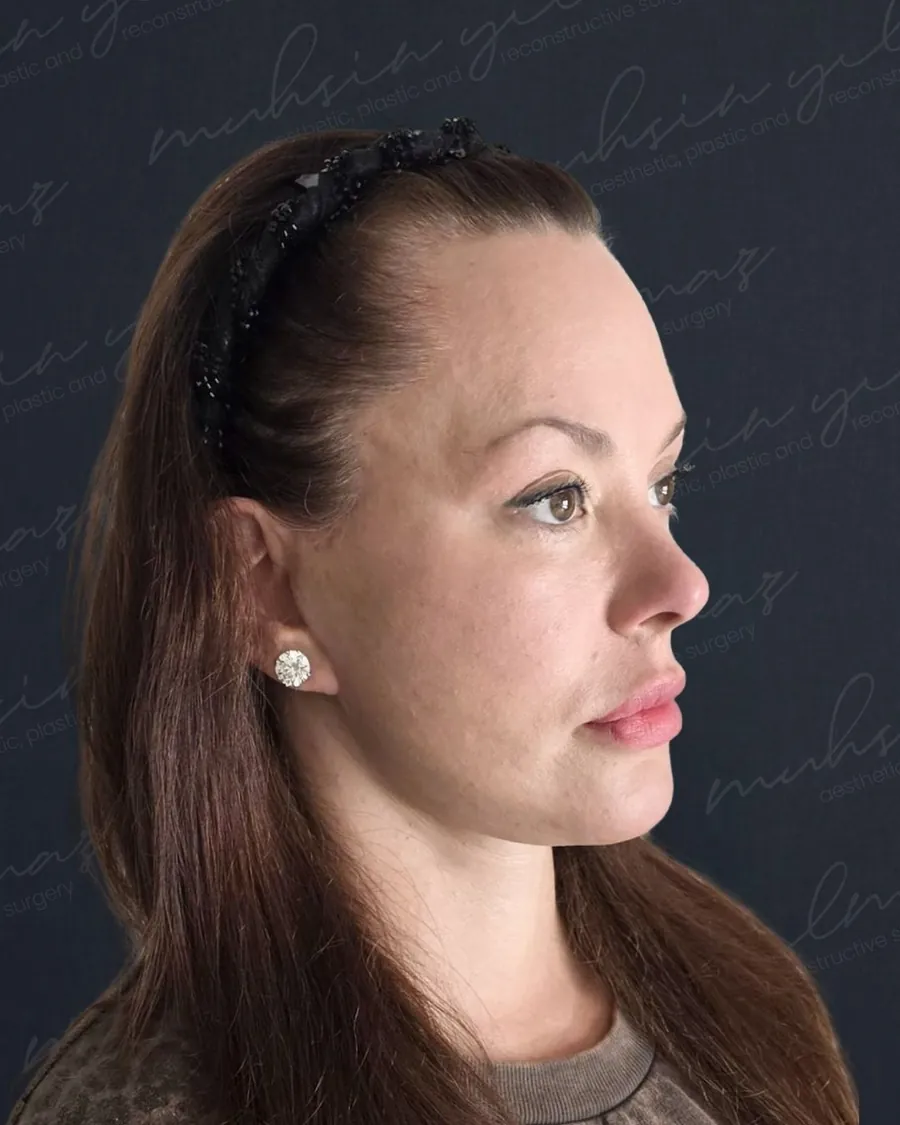


Case 03 — Woman, 58
Extended deep plane facelift · Deep neck lift · Temporal lift · Endoscopic brow lift · Upper & lower blepharoplasty · Canthopexy · Fat grafting


Turkey neck is the informal name for a neck whose front has loosened: skin that hangs below the chin, vertical bands running down from the jaw, and a blunted angle between the chin and the throat. The name comes from a turkey's wattle, which is how a loose neck looks in profile; doctors describe the same changes as neck laxity, submental fullness and platysmal bands.
It is not one problem but up to three, layered on top of each other: loose or crepey skin, fat under the chin, and a muscle that has separated into bands. Most necks have more than one, and the treatment that works is the one that matches the layer that has changed.
Extended deep plane facelift · Deep neck lift · Temporal lift · Endoscopic brow lift · Upper & lower blepharoplasty · Canthopexy · Fat grafting


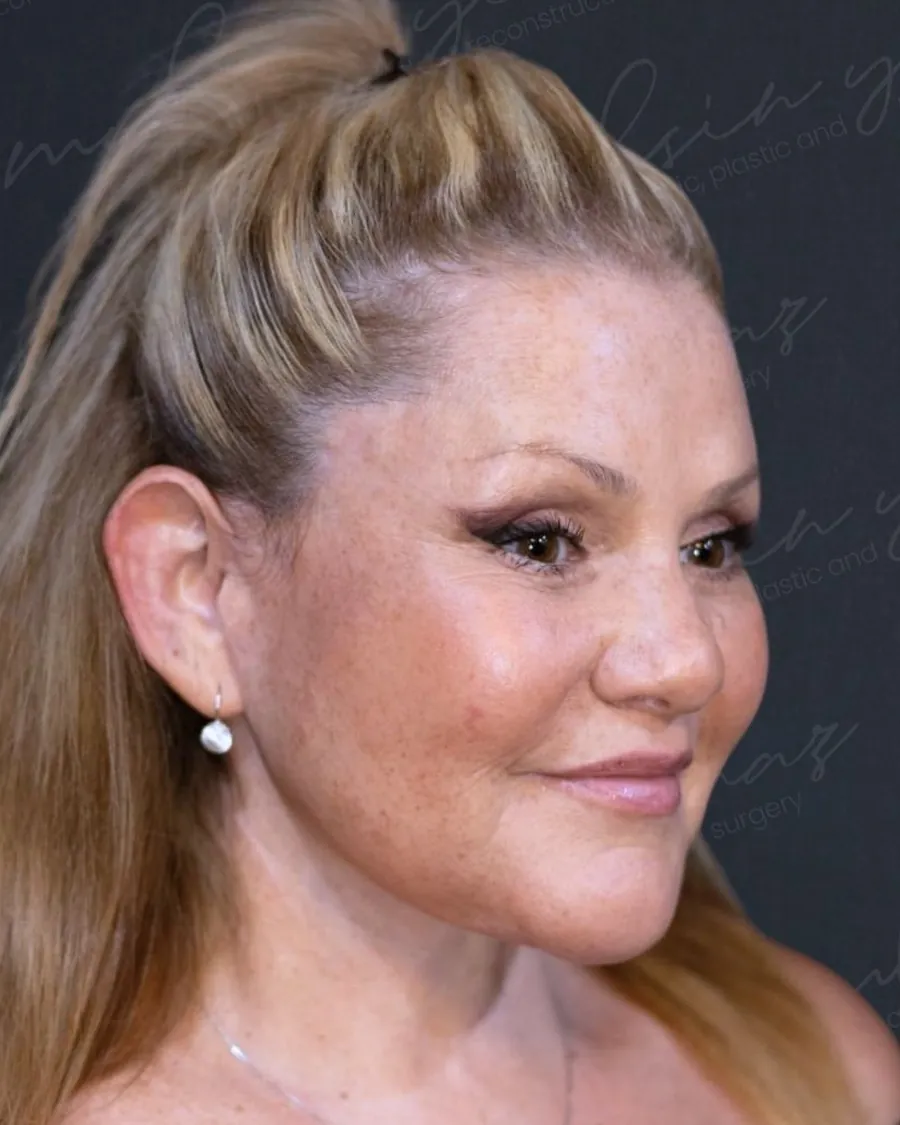

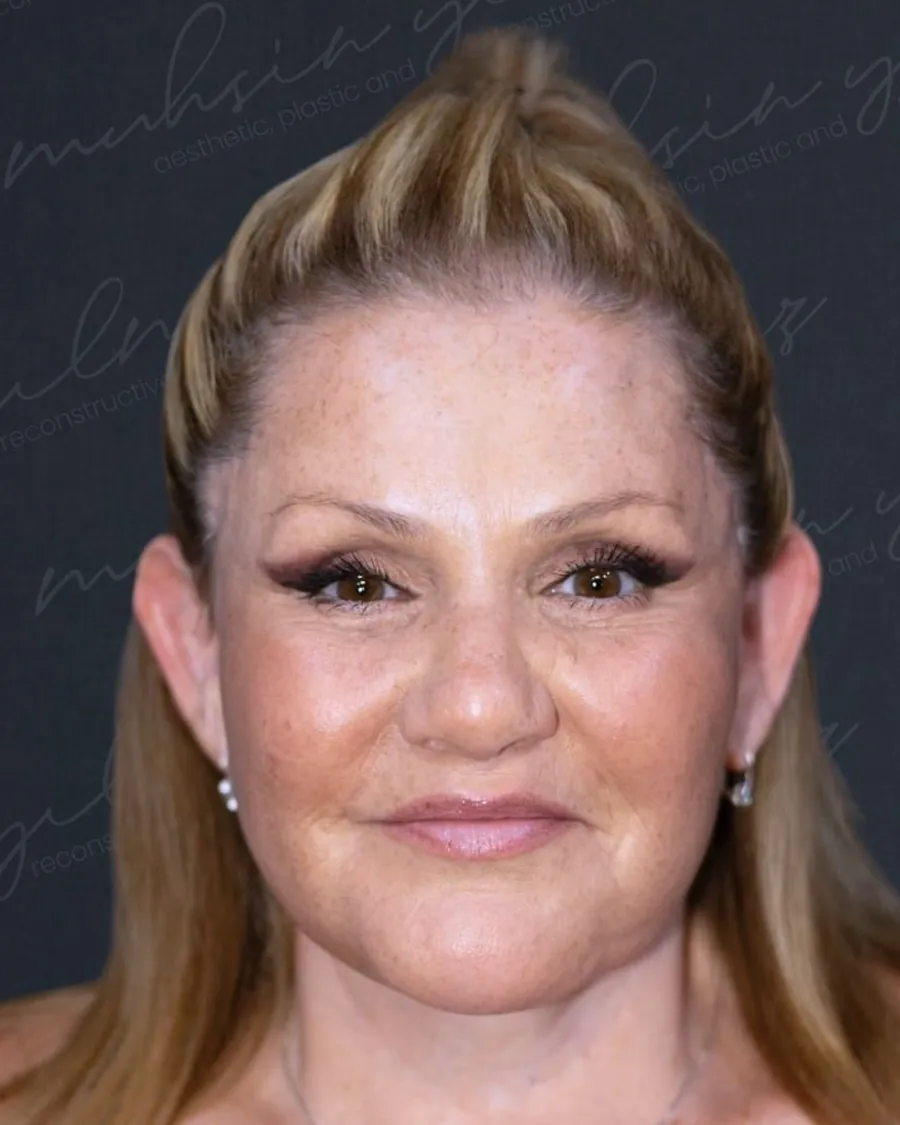
Extended deep plane face & neck lift · Endoscopic forehead lift · Temporal lift · Upper & lower blepharoplasty · Canthopexy · Lip lift · Fat grafting · CO₂ laser resurfacing


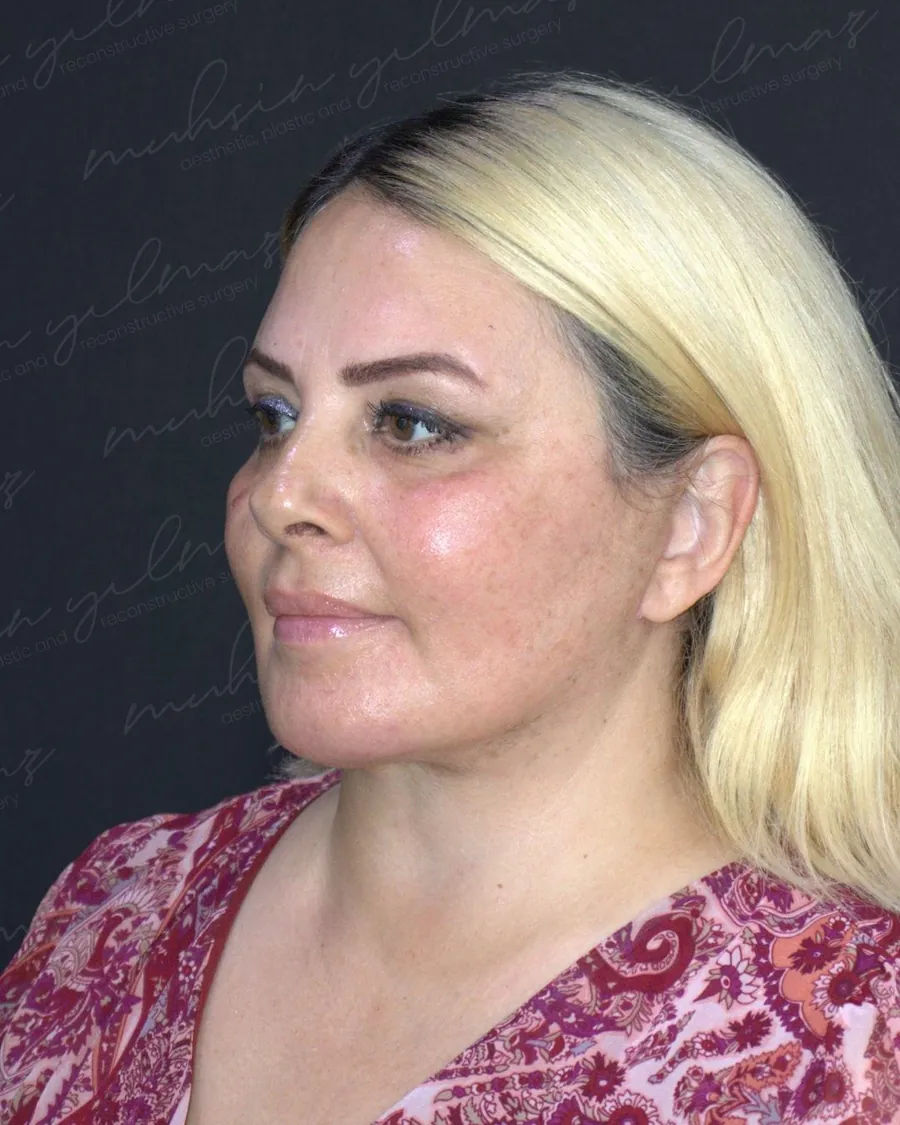


Facelift · Neck lift · Buccal fat removal · Chin implant
Turkey neck is caused by the separation and loosening of the platysma — the thin sheet of muscle at the front of the neck — together with loss of skin elasticity and changes in the fat above and beneath that muscle. Ageing drives all of these, but heredity, weight change, sun exposure and smoking decide how early and how strongly they appear.
In more detail:
Each of these needs a different answer, which is why the first step is working out which ones you have.
Most turkey necks are a mixture, but one layer usually dominates, and it decides the treatment. You can get a first impression in a mirror: look straight ahead with your chin level, then tilt your head back.
If the fullness disappears when you tilt your head back and the skin springs back when you pinch it, superficial fat is the main problem. If the fullness stays, or cords stand out when you clench your teeth and pull the corners of your mouth down, the muscle and the structures beneath it are involved. If the skin hangs in folds whatever you do, loose skin is part of the picture. A photograph in profile with your chin level is how I make the same assessment.
Platysmal bands are the vertical cords that run down the front of the neck when the edges of the platysma muscle separate and become visible. They are often the most noticeable part of a turkey neck, and they stand out more when you speak, strain or grimace.
Bands are a muscle problem, so treatments that work only on the skin or the fat do not correct them. In surgery they are treated by bringing the separated muscle edges together in the midline, usually with work beneath the muscle at the same time; that operation is described on the neck lift page.
Significant weight loss, including weight loss with medications such as semaglutide, often reveals a turkey neck that fullness was hiding — the change people call “Ozempic neck”. The fat has gone, but the skin and muscle it was stretching have not shortened, so the neck can look looser and older than before.
For these necks, removing more fat is almost always the wrong answer; it empties the neck further. What usually helps is redraping the skin and repairing the muscle, which is a neck lift rather than liposuction. I recommend waiting until your weight has been stable before planning surgery.
Turkey neck exercises strengthen the neck muscles, but they do not fix a turkey neck. A turkey neck is not a weak-muscle problem: exercise cannot bring the separated edges of the platysma back together, remove fat beneath the chin or shorten skin that has stretched.
Good posture and a stable weight help the neck look its best, and there is nothing wrong with exercising for its own sake. But once bands, a pocket of fat or loose skin are visible, exercise will not change them, and neck-training devices are no different.
Without surgery, a turkey neck can be improved but not reversed. Non-surgical treatments can tighten the skin slightly, soften bands for a time or reduce a small pocket of fat; none of them repositions the muscle or removes loose skin.
| Option | What it does | What it cannot do | My view |
|---|---|---|---|
| Creams and serums | Improve the surface of the skin | Do not meaningfully tighten loose skin, move fat or treat bands | Good skin care; not a treatment for turkey neck |
| Energy devices (ultrasound, radiofrequency, radiofrequency microneedling) | Heat the skin and the layer just beneath it to tighten it modestly | Do not treat bands, deep fat or significant laxity | Can improve early skin laxity; results are modest |
| Botulinum toxin for bands | Relaxes the platysma so the bands look softer | Does not tighten skin or remove fat; the effect wears off | Can help selected necks with good skin and visible bands |
| Fat-dissolving injections | Reduce a small pocket of fat under the chin | Do nothing for loose skin or bands; can leave irregularities | Rarely the right tool; chin liposuction is more controlled |
| Thread lifts | Pull the skin upward with barbed sutures | Do not treat the muscle or deep fullness; the pull settles | I do not perform thread lifts |
If your change is early and your skin is good, a non-surgical plan can be reasonable. If bands are established or the skin hangs, a non-surgical turkey neck treatment spends money on a result that will not satisfy you.
Botulinum toxin can soften platysmal bands by relaxing the muscle, which makes the cords less visible for as long as the effect lasts. It works best in a neck with good skin and clearly visible bands, and it is a temporary treatment that has to be repeated.
It does not tighten loose skin, remove fat or bring separated muscle edges together, so it does not treat the rest of a turkey neck. When bands are part of a neck that has also loosened, the lasting correction is surgical.
The operation that fixes a turkey neck depends on which layer has changed. Fat alone above the muscle is treated with chin liposuction; bands, deep fullness and a blunted angle with a deep neck lift; and a neck that has loosened together with the jawline with a deep plane facelift and a deep neck lift in one operation.
| What your neck shows | Usual answer in my practice | Where to read more |
|---|---|---|
| A pocket of fat under the chin, good skin, no bands, a sharp jawline | Chin liposuction | Chin liposuction |
| Bands, deep fullness or a blunted angle, with the jawline still sharp | Deep neck lift | Neck lift |
| Loose neck skin with jowls or a softened jawline | Deep plane facelift with a deep neck lift | Deep plane facelift |
| Visible bands with good skin, and no surgery wanted | Botulinum toxin, as a temporary option | — |
Choosing the wrong operation is the main way a turkey neck lift disappoints: liposuction in a loose neck leaves it emptier and looser, and a neck lift under a descended jawline leaves a step at the jaw.
A deep neck lift treats the fullness that sits beneath the platysma — deep fat, the digastric muscles and, when they contribute, prominent submandibular glands — and then repairs the muscle in the midline. It is performed through a short incision in the natural crease under the chin.
This is the part of the neck that liposuction and skin tightening cannot reach, and it is why some patients who have already had their neck treated still see the same heavy neck in photographs. The operation, its incisions and its risks are described in full on the neck lift page.
In most of my patients, a turkey neck and jowls appear together, because the laxity that lets the neck loosen also lets the lower face descend. Lifting the neck under a jawline that has dropped leaves a step at the jaw; lifting the jawline over a neck that needed treating leaves the result unfinished.
For that reason my most frequent operation is an extended deep plane facelift combined with a deep neck lift. A neck lift on its own is the right operation for a younger patient whose change is genuinely confined to the neck.
Men develop a turkey neck in the same way as women, and a heavy neck is often the first thing that reads as age in a male face. The beard and thicker skin change how the incisions are placed and how the skin is redraped, so the operation is planned differently; I cover these differences on the male facelift page.
You are a candidate for turkey neck surgery if your neck has a structural problem — bands, deep fullness, loose skin or a blunted angle — your general health allows surgery, and your weight is stable. Age on its own is not how I decide; anatomy is.
You are probably not a candidate yet if the concern is skin quality rather than structure, if your weight is still changing, or if you cannot stop nicotine for the period safe surgery requires. What I look for in your photographs is set out on the candidate page.
Recovery depends on the operation. Chin liposuction is a short recovery; a deep neck lift or a combined face and neck lift involves more swelling and tightness under the chin, which settles over the following weeks.
Firmness under the chin is the last thing to settle, and judging the result early is judging swelling. The stages are described in the facelift recovery guide.
The cost of turkey neck surgery depends on which operation your neck needs: chin liposuction, a deep neck lift and a combined face and neck lift are different operations, with different operating times, anaesthesia and hospital stays. After I have reviewed your photographs you receive an itemised quote for your own plan.
What a quote includes, and how quotes can be compared safely, is on the cost page.
Turkey neck is caused by separation of the platysma muscle at the front of the neck, loss of skin elasticity and changes in the fat above and beneath the muscle. Ageing drives all three; heredity, weight change, sun exposure and smoking decide how early and how strongly they appear.
It depends on which layer has changed. A pocket of fat under the chin with good skin is treated with chin liposuction; bands and deep fullness with a deep neck lift; and a loose neck with jowls with a deep plane facelift and a deep neck lift together. Non-surgical treatments can soften an early turkey neck but do not remove it.
No. Exercise strengthens muscle, but it cannot bring the separated edges of the platysma together, remove fat under the chin or shorten skin that has stretched. Good posture and a stable weight help the neck look its best, but they do not reverse a turkey neck.
No. Creams can improve the surface of the skin, but they do not meaningfully tighten loose skin, move fat or treat neck bands. They are skin care, not a treatment for the structures that form a turkey neck.
It can soften platysmal bands for a time by relaxing the muscle, and it works best in a neck with good skin. It does not tighten loose skin, remove fat or repair the separated muscle, and the effect wears off, so it is not a lasting correction for a turkey neck.
You can improve an early turkey neck without surgery, but you cannot remove it. Energy devices can tighten skin modestly, Botox can soften bands for a time, and fat-dissolving injections can reduce a small pocket of fat. None of them repositions the muscle or removes loose skin.
A deep neck lift, which treats the fullness beneath the platysma and repairs the muscle in the midline, is the operation for bands and deep fullness. When the jawline has descended too, it is combined with a deep plane facelift. Chin liposuction is enough only when the problem is fat alone in a neck with good skin.
Yes, when the change is genuinely confined to the neck, which is typically a younger patient with inherited fullness or early bands. When the jowls and the jawline have descended too, I recommend treating face and neck together, because lifting the neck alone leaves a mismatch at the jaw.
Not the neck you had. A deep neck lift repairs the muscle and treats the structures beneath it, so the correction is structural, and the neck continues to age from its new starting point rather than returning to where it was. A stable weight helps the result hold.
It depends on the operation your neck needs: chin liposuction, a deep neck lift and a combined face and neck lift are different operations. After I have reviewed your photographs you receive an itemised quote for your own plan.
Send a photograph in profile with your chin level and one looking straight ahead; I will tell you whether your neck is a fat, muscle or skin problem — or a combination — and what I would recommend.
Request a personal review See before & after results
Every enquiry is reviewed personally by Dr. Yilmaz; scheduling is handled by the patient coordination team.
Written and medically reviewed by Muhsin Yilmaz, MD, FEBOPRAS — Plastic, Reconstructive and Aesthetic Surgeon. Last reviewed: October 2026.
Dr. Muhsin Yilmaz is a double board-certified plastic surgeon, holding the FEBOPRAS diploma of the European Board of Plastic, Reconstructive and Aesthetic Surgery and the certification of the Turkish Board of Plastic, Reconstructive and Aesthetic Surgery, and practises in Istanbul, Türkiye. His practice is focused on facial and neck rejuvenation, centred on the deep plane facelift — around 150 facelift operations per year, performed at Acıbadem Kartal Hospital. He is a member of TSPRAS and ISAPS, and is registered with the Turkish Ministry of Health for international health tourism. Read his full profile.