

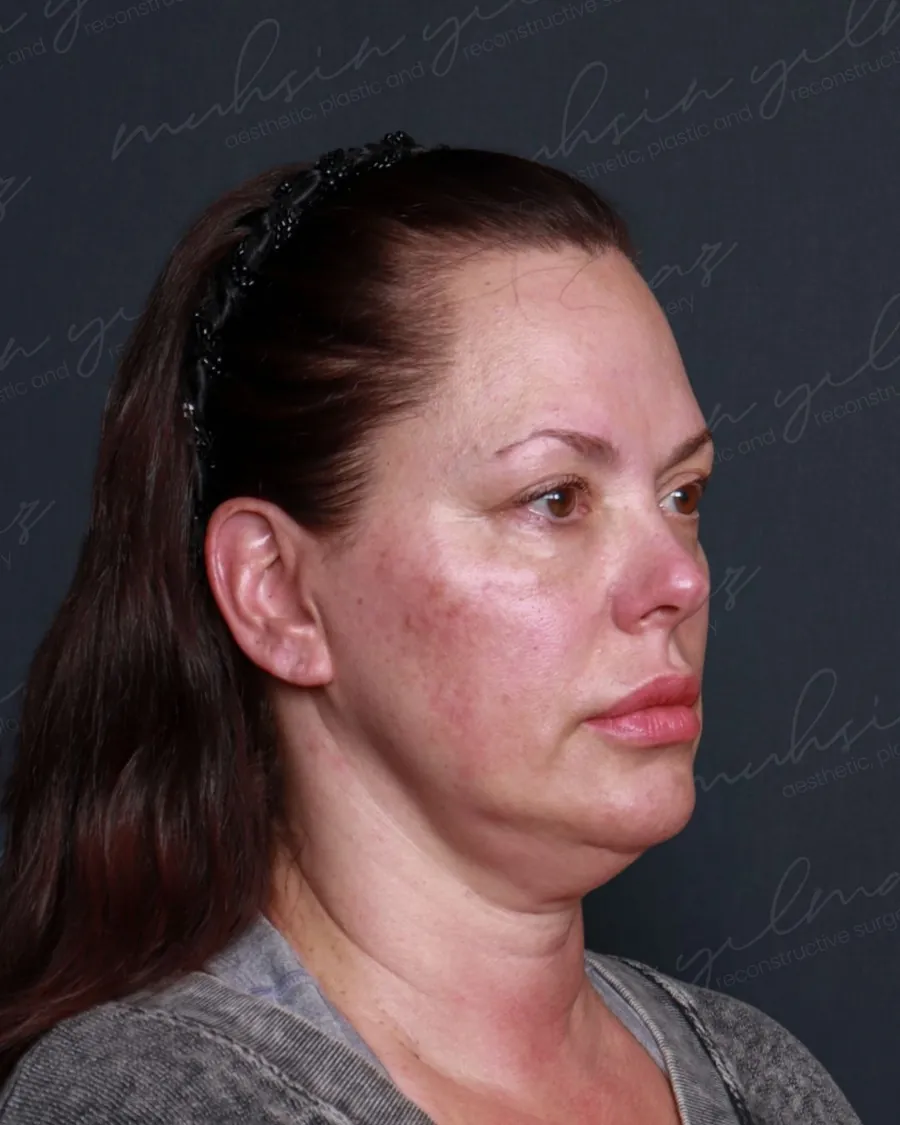
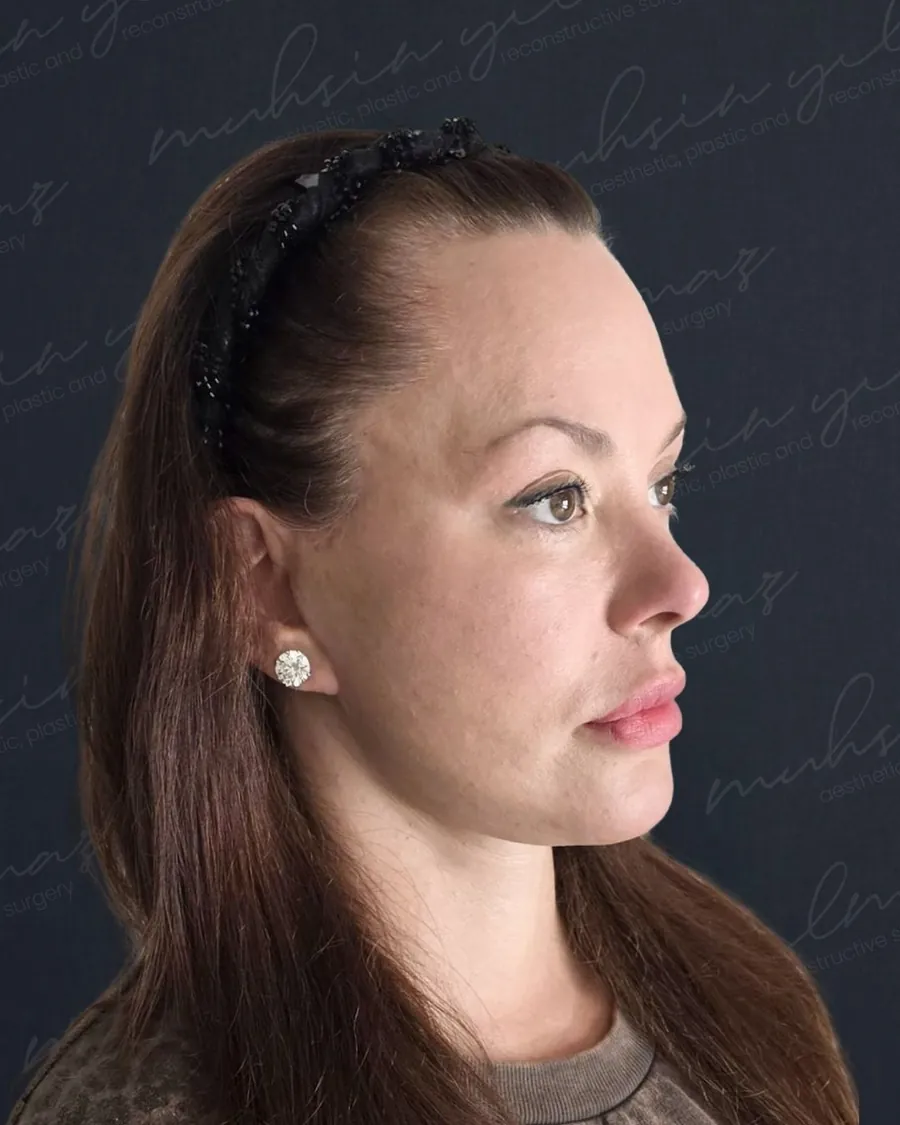

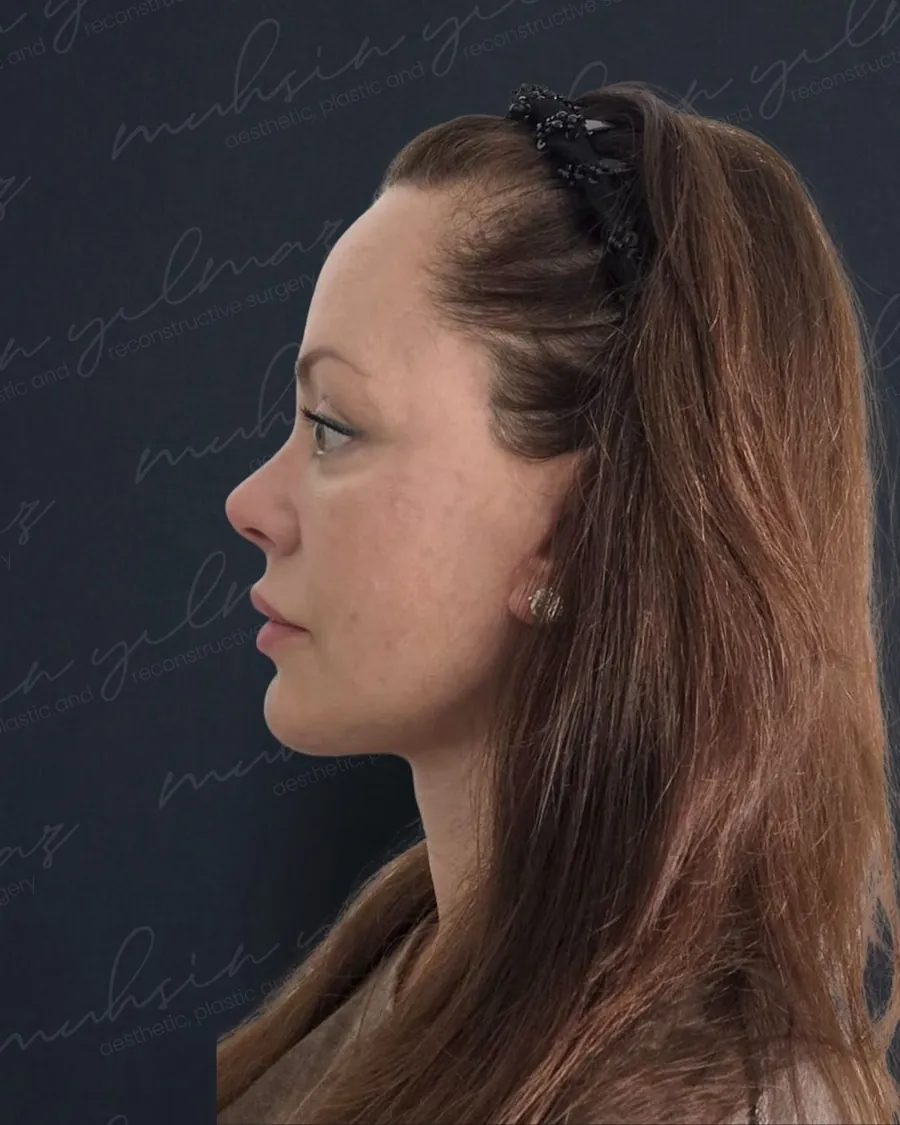


Case 03 — Woman, 58
Extended deep plane facelift · Deep neck lift · Temporal lift · Endoscopic brow lift · Upper & lower blepharoplasty · Canthopexy · Fat grafting




Jowls are the sagging tissue that collects on either side of the chin, along and just below the jawline. They form when the deeper layers of the cheek lose their support and slide downward, pooling against the mandibular ligament near the chin. A youthful jawline is a single clean line from ear to chin; a jowl interrupts that line and creates the “bulldog” or marionette appearance patients describe.
Jowls are not a skin problem. The skin is only the surface; what has moved is the fat and the fibrous layer beneath it. This is why creams, skin tightening and skin-only surgery do not treat them.
Extended deep plane facelift · Deep neck lift · Temporal lift · Endoscopic brow lift · Upper & lower blepharoplasty · Canthopexy · Fat grafting


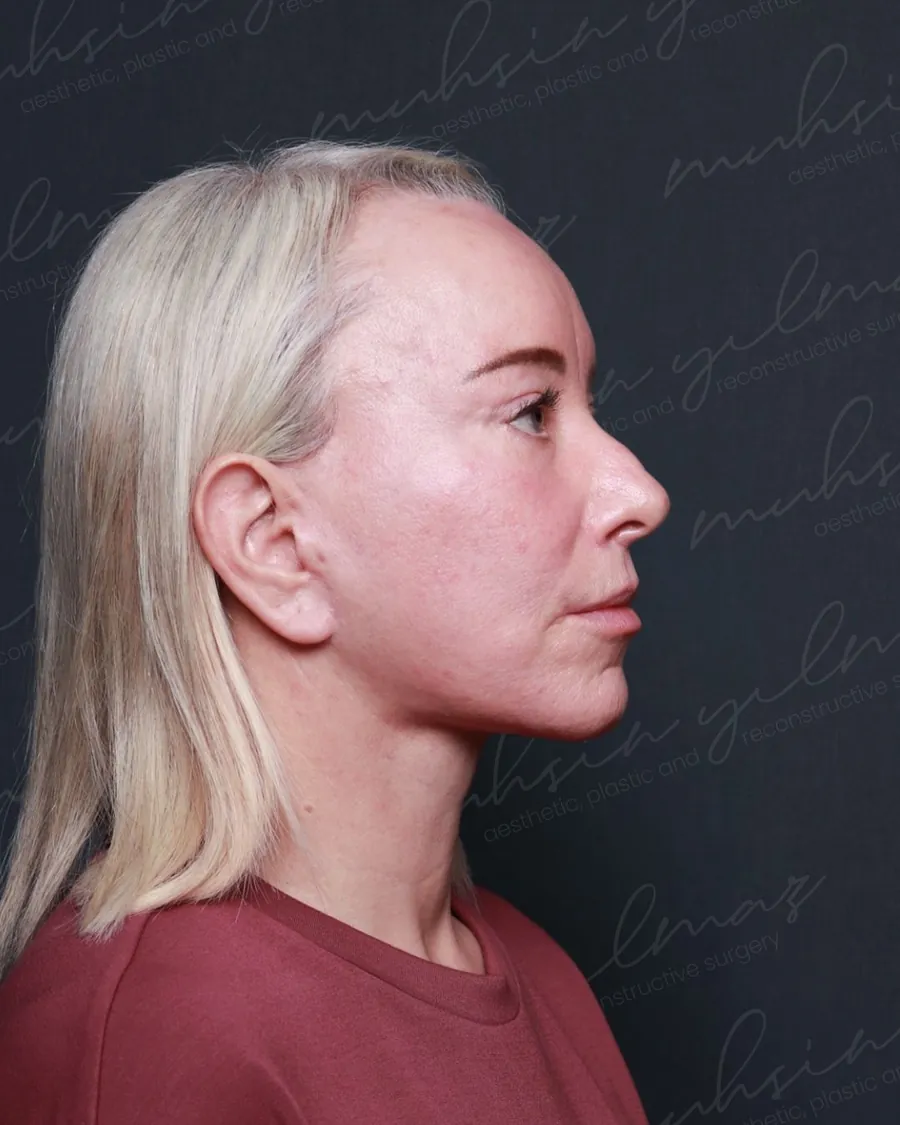


Revision extended deep plane face & neck lift · Upper & lower blepharoplasty · Canthopexy · Forehead lift · Temporal lift · Lip lift · Corner lip lift · Fat grafting · CO₂ laser

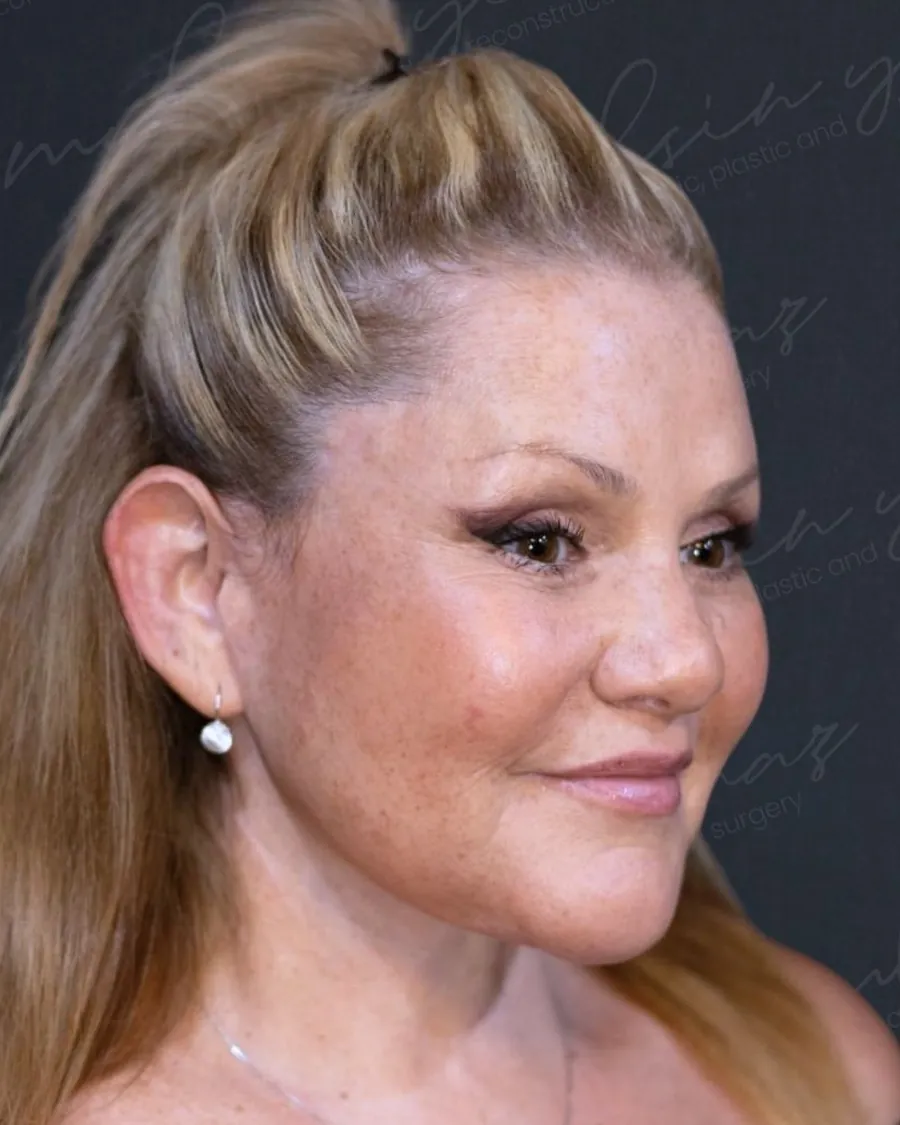


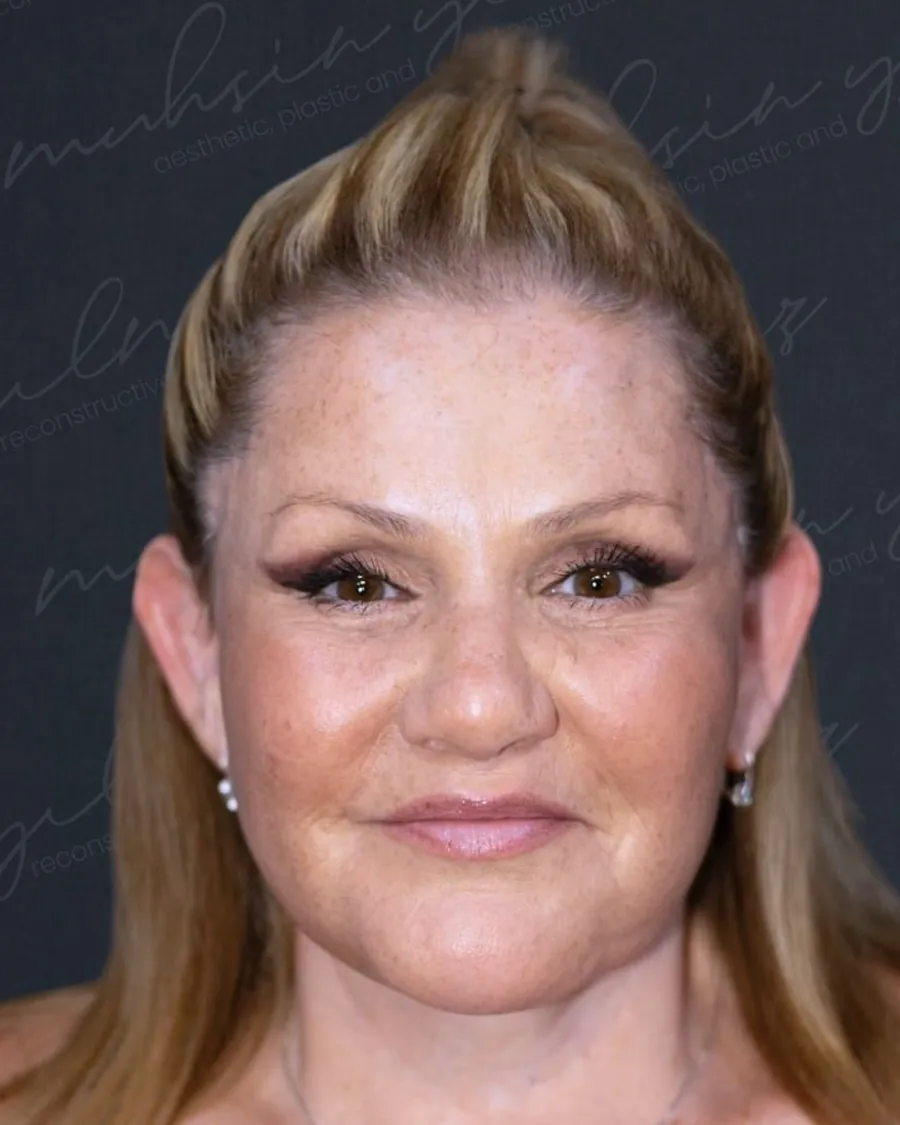
Extended deep plane face & neck lift · Endoscopic forehead lift · Temporal lift · Upper & lower blepharoplasty · Canthopexy · Lip lift · Fat grafting · CO₂ laser resurfacing
Jowls are caused by the loosening of the cheek's retaining ligaments, the gradual descent of the deep cheek fat and the fibromuscular layer (the SMAS), and the loss of bone volume along the jaw. All four happen with age, but they happen at different speeds in different people.
In more detail:
Understanding the cause matters because every effective treatment has to address the layer that has moved, not the skin above it.
Most jowls are a mixture of descended deep tissue and a small amount of fat, but the balance differs between patients and it decides the treatment. A simple test: tilt your head back and look in the mirror. If the jowl disappears when the tissue is lifted, it is sagging tissue and needs to be repositioned. If a fullness remains under the jawline even with the head tilted back, there is a fat component that needs to be removed.
There is a third pattern I see often: a jowl that is mostly sagging tissue, with a fatty neck below it. These patients need the jawline repositioned and the neck treated together; treating one without the other leaves the result unbalanced.
Rapid weight loss, including weight loss with GLP-1 medications, reveals jowls that were previously hidden by facial fullness. The fat that filled the cheek and padded the jawline is gone, but the stretched ligaments and the descended deep tissue remain, so the face can look older after weight loss than before it. This is the pattern behind the phrase “Ozempic face”.
For these patients the answer is almost never filler alone. Replacing lost volume with filler in a face whose support has failed produces a heavy, puffy look. The deep tissue has to be lifted back to where it belongs first; volume, if needed, is restored afterwards with the patient's own fat.
Early, mild jowls can be softened without surgery, but they cannot be removed. Nothing that works through the skin can lift tissue that has slid beneath it. Non-surgical treatments either add volume around the jowl to disguise it, tighten the skin above it, or reduce a small amount of fat; none of them repositions the deep tissue that has moved.
If your jowl is early and your skin is good, a non-surgical plan can buy time. If the jowl is established, a non-surgical plan spends money on a result that will not satisfy you. Being honest about which group you are in is the most useful thing a consultation can do.
Fillers, thread lifts and energy-based skin tightening are the three non-surgical options patients ask about for jowls. Each has a narrow role and clear limits.
| Option | What it does | What it cannot do | My view |
|---|---|---|---|
| Dermal filler | Adds volume in front of and behind the jowl to straighten the jawline visually | Does not lift anything; the jowl is still there under the filler | Reasonable for a very mild jowl; counterproductive after weight loss |
| Thread lift | Pulls the skin and superficial tissue upward with barbed sutures | Does not reach the deep layer; the lift settles as the threads lose tension | I do not perform thread lifts; the result is temporary and repeat sessions scar the tissue I later need to operate on |
| Energy devices (ultrasound, radiofrequency) | Tightens the skin and the layer just under it by heating | Does not move descended fat or SMAS | Can modestly improve skin quality; does not treat the jowl itself |
| Fat-dissolving injections | Reduces a small fat pocket | Does nothing for sagging tissue; can leave irregularities | Rarely useful at the jowl; chin liposuction is more controlled |
A mini facelift tightens the skin and the superficial layer through a short incision in front of the ear. It is marketed as the solution for early jowls, and it is the operation I most often see patients regret. Because it works on the skin and the superficial tissue, it pulls the jowl sideways instead of lifting it; the skin takes the tension, the deep tissue stays where it was, and the jowl returns early.
I do not offer a mini facelift. A patient with an early jowl is a good candidate for a deep plane procedure that is smaller in extent, not for a procedure that works on the wrong layer.
The operation that removes jowls is a deep plane facelift, because it is the only approach that releases the retaining ligaments and lifts the descended cheek tissue back up as a single unit. The fat and SMAS that formed the jowl are repositioned over the jawline, the mandibular ligament area is released so nothing piles up against it, and the skin is redraped without tension. There is no separate operation called a “jowl lift”; when a surgeon offers one, it is either a deep plane procedure under another name or a skin-tightening procedure that will not last.
Patients whose concern is limited to the jawline and the lower face often ask about a lower facelift. In my practice this is a deep plane facelift focused on the lower face and neck; I explain the technique and how I decide its extent on the deep plane facelift page.
A jowl rarely exists alone. The same laxity that lets the cheek tissue descend lets the neck muscles separate into bands and the fat under the chin accumulate. If I correct the jawline and leave the neck, the result looks unfinished, so in most patients jowl surgery is combined with a deep neck lift in the same operation. I explain the neck itself, including the muscle bands and the under-chin fat, on the neck lift page.
A small group of patients, usually younger, have a jowl that is genuinely fat with good tissue support behind it. For them, removing the fat with liposuction under the chin and along the jawline is enough, and a facelift would be an overtreatment. I decide this at examination, not from photographs, because a fat-only jowl and an early sagging jowl can look identical in a picture. The procedure is described on the chin liposuction page.
Men develop jowls in the same way as women but notice them later and tolerate them less well, because a heavy jawline is the first thing that reads as age in a male face. Male skin is thicker and the beard changes how incisions are placed, so the operation is planned differently. I cover these differences on the male facelift page.
You are a candidate for jowl surgery if the jowl is formed by sagging tissue, your general health allows an operation under general anaesthesia, and you want a result that is natural rather than tight. The decision does not depend on age; it depends on what has happened to the tissue.
You are probably not yet a candidate if the jowl disappears when you smile, if it is purely fat with good support behind it, or if your expectation is a change nobody will notice. I discuss how I assess candidates in detail on the candidate page.
A well-planned jowl correction gives a continuous jawline from the ear to the chin, with the shadow under the jaw restored and no visible pull at the mouth corners. Because the deep tissue is repositioned rather than the skin stretched, the face looks rested, not operated. Patients who have had this surgery and consented to share their photographs are on the results page.
Recovery after a deep plane facelift for jowls follows the same course as any deep plane procedure: swelling and bruising that settle in stages, and a jawline that keeps refining as the deeper tissue heals. Because the skin carries no tension, the incision lines fade well. I describe the week-by-week course on the facelift recovery page.
The cost of jowl surgery depends on whether the jawline alone is treated or the neck and midface are included, which is decided at consultation. I explain what the fee covers, what is paid to the hospital and what changes the figure on the cost page.
Jowls are caused by loosening of the cheek's retaining ligaments, descent of the deep cheek fat and SMAS layer, and loss of bone along the jaw. The descended tissue piles up against the mandibular ligament near the chin, which is why jowls sit where they do. Weight loss, smoking, sun and heredity accelerate the process.
No. Jowls are descended deep tissue, and nothing in the skin's natural repair cycle moves that tissue back. Weight gain can hide them temporarily by filling the face, and weight loss reveals them again. Once the ligaments have stretched, the only way to restore the jawline is to reposition the tissue surgically.
You can soften early jowls without surgery, but you cannot remove them. Filler in front of and behind the jowl straightens the jawline visually, and energy devices tighten the skin modestly. Neither lifts the tissue that has moved. If the jowl is established, a non-surgical plan will not give you the result you are picturing.
Not as a separate operation. “Jowl lift” is a marketing term; what actually lifts a jowl is a facelift that works in the deep plane and releases the ligaments holding the tissue down. When a clinic offers a jowl lift as a quick procedure, it is almost always a skin-tightening operation that pulls the jowl sideways and returns early.
The best treatment depends on what the jowl is made of. Sagging tissue needs a deep plane facelift, usually with a neck lift; a fat-only jowl with good support needs chin liposuction; a very mild early jowl can be softened with filler. I decide this at examination, not from photographs.
There is no fixed age. Jowls appear when the retaining ligaments stretch enough for the deep tissue to descend, and that depends on heredity, weight history, sun exposure and smoking more than on the calendar. Some patients see them in early middle age; others not until much later.
It corrects them structurally. The tissue that formed the jowl is lifted back into position and the ligaments are reset, so the face continues to age from a younger starting point rather than returning to where it was. Ageing does not stop, but the jowl you had is gone.
Not the jowl you had. A deep plane facelift repositions the deep tissue and holds it in place; the skin carries no tension, so there is nothing to stretch back. The face keeps ageing from its new position. A skin-only or mini facelift is different: it pulls skin over a jowl that is still there, and that result does not hold.
In my practice, no. A mini facelift works on the skin and the superficial layer; the jowl is in the deep layer. The operation pulls the jowl sideways rather than lifting it, the skin takes the tension, and the problem returns early. I do not perform mini facelifts for this reason.
Yes, and in most patients they should be. The laxity that causes jowls also causes neck bands and under-chin fullness, and correcting the jawline while leaving the neck gives an unbalanced result. A deep plane facelift and a deep neck lift are performed together in one operation.
Send photographs for an initial assessment; I will tell you whether the problem is fat, sagging tissue or both, and what I would recommend.
Request a personal review See before & after results
Every enquiry is reviewed personally by Dr. Yilmaz; scheduling is handled by the patient coordination team.
Written and medically reviewed by Muhsin Yilmaz, MD, FEBOPRAS — Plastic, Reconstructive and Aesthetic Surgeon. Last reviewed: October 2026.
Dr. Muhsin Yilmaz is a double board-certified plastic surgeon, holding the FEBOPRAS diploma of the European Board of Plastic, Reconstructive and Aesthetic Surgery and the certification of the Turkish Board of Plastic, Reconstructive and Aesthetic Surgery, and practises in Istanbul, Türkiye. His practice is focused on facial and neck rejuvenation, centred on the deep plane facelift — around 150 facelift operations per year, performed at Acıbadem Kartal Hospital. He is a member of TSPRAS and ISAPS, and is registered with the Turkish Ministry of Health for international health tourism. Read his full profile.