



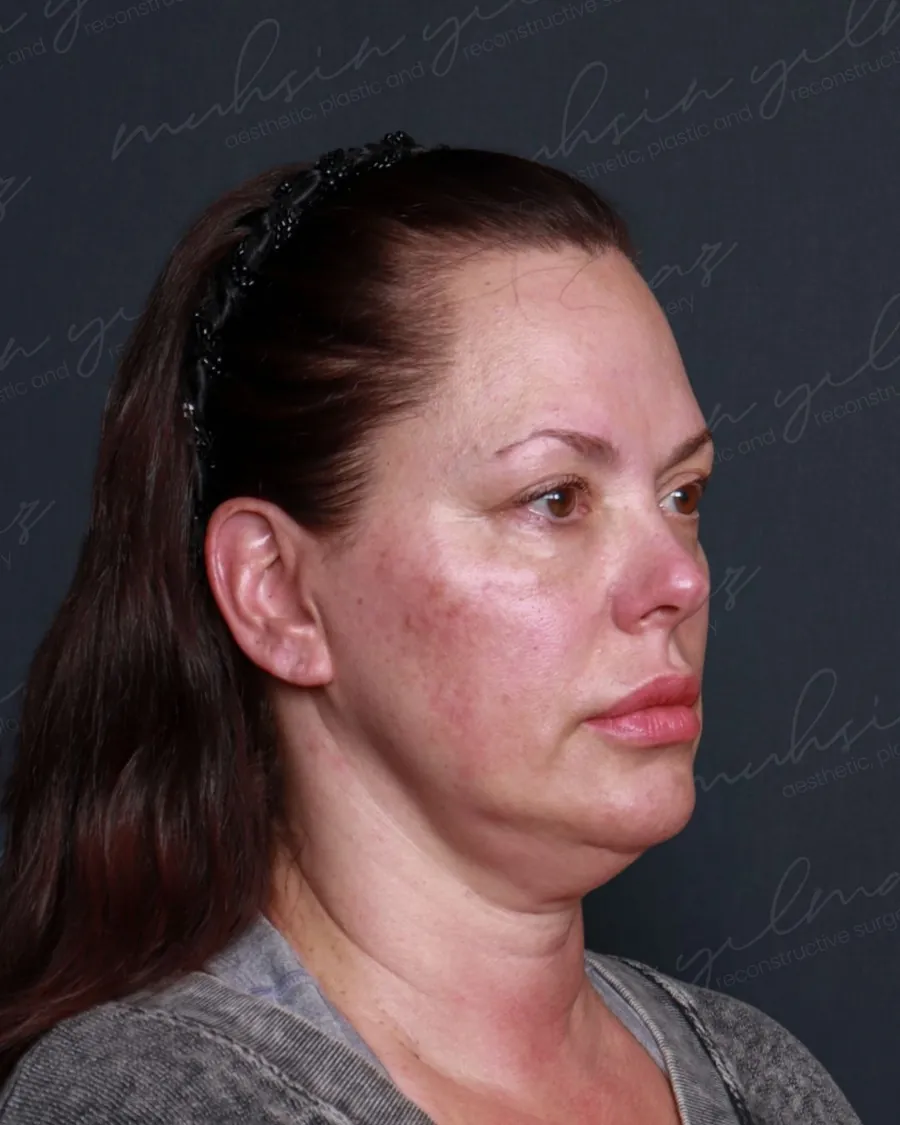
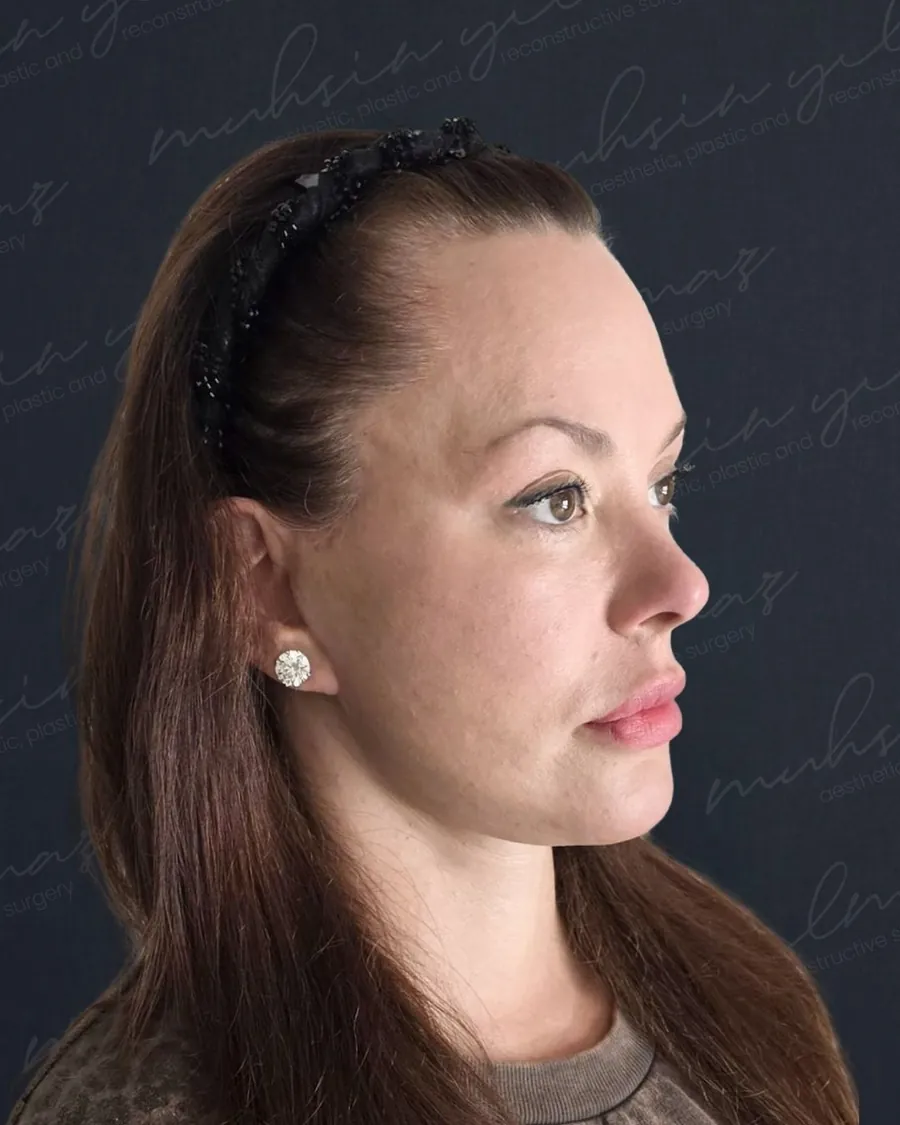


Woman, 58 · Extended deep plane facelift + Deep neck lift + Temporal lift + Endoscopic brow lift + Upper & lower blepharoplasty + Canthopexy + Fat grafting
Case 03 in the gallery




A neck lift addresses the changes that blunt the neck's definition: vertical platysma bands, fullness under the chin, a heavy or undefined jawline, and the loss of the crisp angle between chin and neck. Which of these you have determines the operation — there is no single "neck lift". Skin laxity alone, muscle banding, and deep structural fullness are three different problems, and treating the wrong one is the most common reason neck surgery disappoints. That is why my planning starts with where the problem actually sits: skin, muscle, or the compartment beneath the muscle.
A deep neck lift treats the space underneath the platysma muscle — the layer standard neck lifts never reach. Through a small incision hidden under the chin, I can reduce subplatysmal fat, conservatively manage the anterior digastric muscles, and, when they contribute to fullness, address prominent submandibular glands — then repair the platysma in the midline.
This matters because in many necks the fullness is not under the skin at all; it is under the muscle. Liposuction or skin tightening cannot reach it, which is why some patients have "had their neck done" elsewhere and still see the same heavy neck in photographs. Deep neck surgery demands precise anatomical knowledge — the structures involved sit close to important nerves — and it is exactly the kind of surgery where a facelift-focused practice matters.
Unretouched photographs of Dr. Yilmaz's own patients, published with written consent. Both cases appear in the before & after gallery, where every patient is shown from three angles.
Case 03 in the gallery


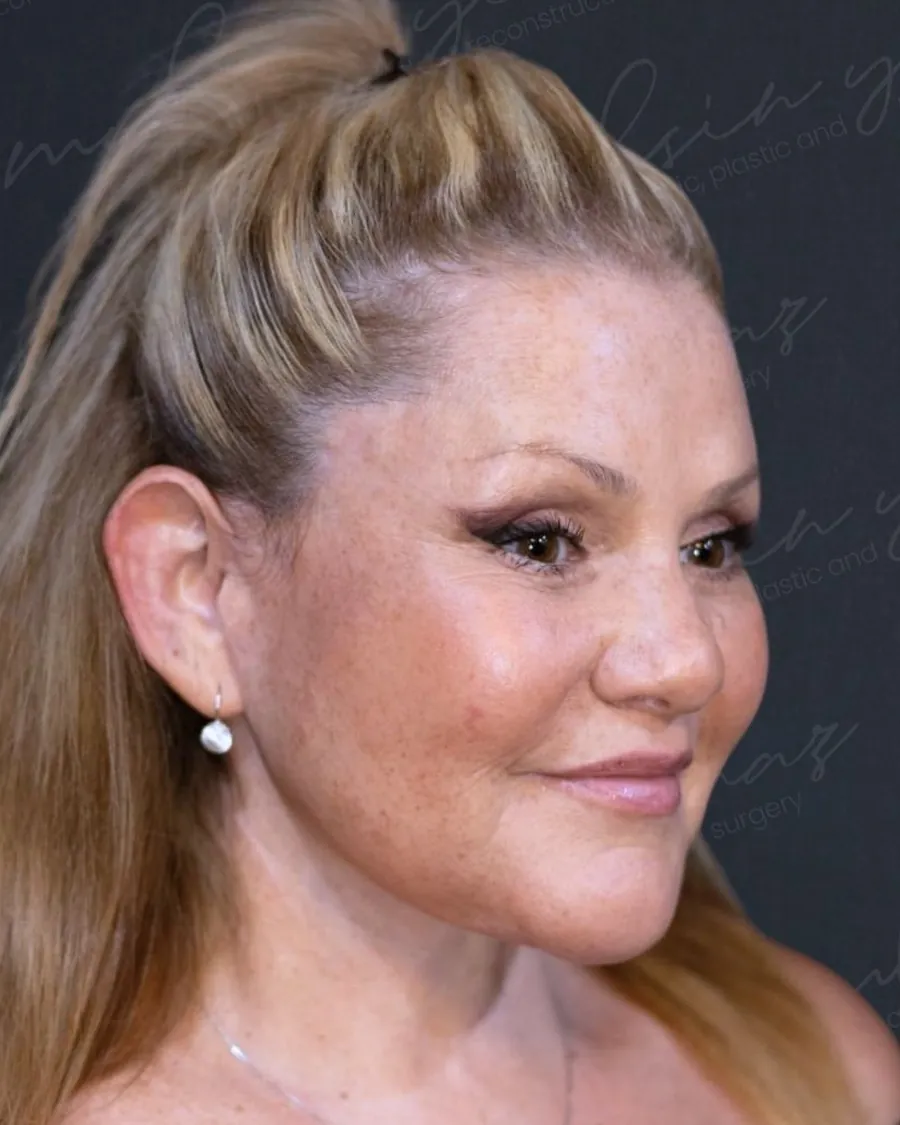

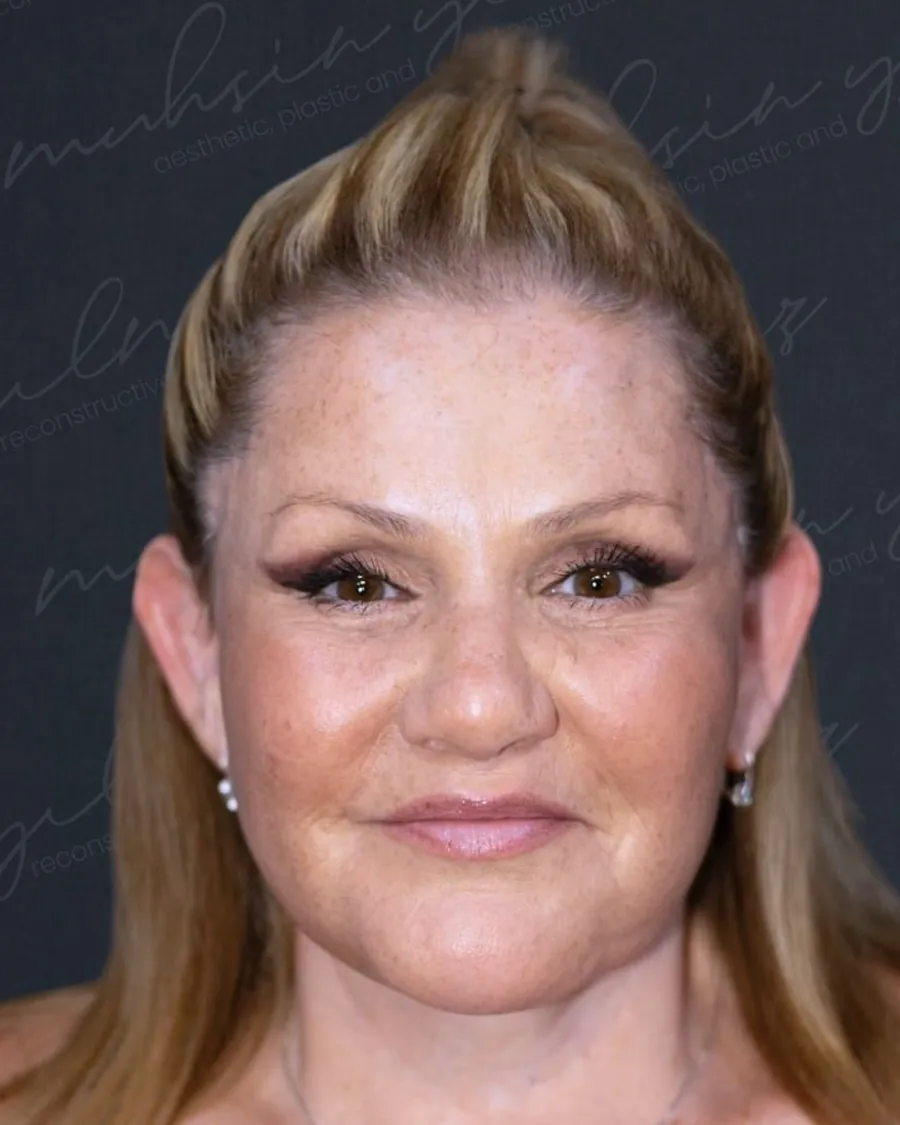
Combined face and neck plan · Case 05 in the gallery
The jawline is the border between face and neck, and it ages as one unit — which is why the best results in heavy or structural necks come from treating face and neck together, and why my most frequent operation is the extended deep plane facelift combined with a deep neck lift. Lifting the neck without repositioning the descended deep tissues of the lower face leaves a mismatch at the jawline; treating both in one plan produces the continuous, natural line international patients travel for.
An isolated neck lift has its place: typically a younger patient whose complaint is genuinely confined to the neck — an inherited full neck, early banding, a blunted angle — with a lower face that has not yet descended. Which of these describes you is a consultation question, and I will tell you honestly if the answer is "neck only", "face and neck", or "no surgery yet".
Chin liposuction can be enough when the excess is fat under the skin and skin and muscle tone are good. When fullness sits beneath the muscle, or bands and laxity are present, liposuction alone cannot correct the underlying problem. At consultation, I assess which layer is responsible before recommending liposuction, a neck lift or deeper neck work.
Four different problems need four different operations — this is how they compare.
| Aspect | Chin liposuction | Neck lift | Deep neck lift | Combined face & neck lift |
|---|---|---|---|---|
| Targets | Fat under the skin | Platysma muscle laxity and banding, loose skin | Fullness beneath the muscle: subplatysmal fat, digastric muscles, submandibular glands | Descended lower face plus any of the neck problems |
| Layer treated | Subcutaneous | Muscle + skin | Below the platysma | Deep plane of face + neck layers |
| Incisions | Tiny punctures | Under the chin; around the ears if skin is redraped | Short incision hidden under the chin | Facelift incisions + under the chin |
| Typical candidate | Good skin and muscle tone, isolated fat | Banding or laxity confined to the neck | Heavy neck that persists after weight loss or previous surgery | Jawline and neck ageing together — the most common situation |
Good candidates have a structural problem: banding, deep fullness, real laxity, a blunted neck angle. General health must allow elective surgery under general anesthesia, and nicotine must be stopped for the required period — I do not operate on patients who cannot stop smoking. I advise against neck surgery when the concern is skin quality rather than structure (there are better tools for that), when expectations are not realistic — a neck lift restores your neck's best version, not someone else's neck — and when weight is still changing significantly. Age by itself is not a criterion; anatomy is.
Neck lift surgery takes place under general anesthesia at a fully equipped hospital in Istanbul with intensive-care infrastructure — not in an office setting. Incisions are placed where they are designed to disappear: a short incision in the natural crease under the chin and, when skin needs redraping, fine incisions around and behind the ears. The operation typically takes two to three hours, longer when combined with a facelift.
Nerve safety is central to how I operate: the marginal mandibular nerve runs directly through this territory, and my background — microsurgical training and doctoral research on peripheral nerves — together with routine use of an intraoperative nerve stimulator, is built around protecting it. Anesthesia follows the same protocol as my facelift surgery, including continuous depth monitoring and clot-prevention measures.
You stay in Istanbul until I have seen you at your clinic visits and confirmed at your final check that you are fit to fly — that decision is medical, not a date on a booking. The nights in hospital are for close monitoring in the hours when bleeding is most likely; how the trip around them is arranged is on travelling to Istanbul.
Swelling and tightness under the chin are normal in the first weeks, and residual firmness settles over the months that follow. Once you are home, follow-up continues by photograph and video call at agreed intervals, with a direct line to the team that operated on you. The stages of recovery are in my recovery guide.
Honest surgery starts with naming the risks. The relevant ones here are bleeding and haematoma in the first hours (the reason for two monitored hospital nights), temporary weakness of the lower-lip branch of the facial nerve (usually neuropraxia that recovers; permanent injury is rare and is what the nerve-safety protocol exists to prevent), contour irregularities, seroma, and scars that need time to fade.
Deep neck surgery in particular should be done by surgeons who operate in this anatomy routinely. If a result ever needs refinement, I assess it the way I assess all revision surgery: after the tissues have fully settled, not before.
A structural repair lasts because it corrects structure: the deep work does not wear off, and the neck continues to age from a younger starting point rather than returning to where it was. How a result changes over time depends on what was done — deep repair holds better than skin tightening alone — on your tissue quality and on a stable weight. I do not attach a number of years to it; what a neck lift does is reset the starting point, not stop time.
There is no single price, because there is no single operation — an isolated neck lift, a deep neck lift, and a combined face-and-neck plan are different surgeries. After a video consultation I provide a transparent, itemised quote for your specific plan; what determines the cost is explained here. Before-and-after photographs of face and neck patients are in the results gallery. The main factors are the scope of the plan — an isolated neck lift, a deep neck lift or combined face-and-neck surgery involve different operating times and anesthesia; the two monitored hospital nights; and what the quote includes: hospital fees, pre-operative tests, recovery-hotel coordination and a year of structured follow-up. The quote you receive is itemised, so you can see each of these lines before deciding.
A standard neck lift tightens the platysma muscle and redrapes skin. A deep neck lift also treats the compartment beneath the muscle — subplatysmal fat, the digastric muscles and, when needed, prominent submandibular glands. When fullness sits below the muscle, only a deep neck lift can correct it.
Yes, when the problem is genuinely confined to the neck — typically younger patients with inherited fullness or early banding. When the lower face has descended too, I recommend treating face and neck as one unit, because lifting the neck alone leaves a mismatch at the jawline.
Only when the excess is fat under the skin in a patient with good skin and muscle tone. If the fullness is under the muscle, or bands and laxity are present, liposuction alone will disappoint — this distinction is exactly what the consultation determines.
In the natural crease under the chin and, when skin redraping is needed, in the folds around and behind the ears. They are designed to sit where the eye does not look, and they fade over months.
Most patients describe tightness and pressure rather than severe pain, controlled with simple medication. The first days are about swelling and rest; when you will be socially presentable depends on what was done, and the indicative range is in the summary at the top of this page.
When I have confirmed at your final in-person check that you are fit to fly — the decision is medical, not a date on a booking. After that, follow-up continues remotely by photograph and video call at agreed intervals.
The midline muscle repair is durable; normal ageing continues, but corrected bands do not simply reappear. Longevity is best when the deep structures were treated, not just the skin.
Look for a facelift-focused practice, and ask specific questions: how the surgeon handles the structures beneath the platysma, how the marginal mandibular nerve is protected, and how many face-and-neck operations they perform each year. Consistent, unretouched before-and-after photographs of necks — not just faces — are the best evidence.
There is no standard price, because the operation is planned individually — isolated neck lift, deep neck lift and combined face-and-neck surgery are different plans. After a video consultation you receive a transparent, itemised quote.
Send your photographs for a personal review by Dr. Muhsin Yilmaz. You will receive a considered opinion on whether your neck needs skin, muscle or deep structural work — or face and neck together — and a clear answer if surgery is not the right decision for you. You can share your photographs over WhatsApp, or simply send the form — the patient coordination team will request them from you afterwards.
Request a personal review See before & after results
Every enquiry is reviewed personally by Dr. Yilmaz; scheduling is handled by the patient coordination team.
Written and medically reviewed by Muhsin Yilmaz, MD, FEBOPRAS — Plastic, Reconstructive and Aesthetic Surgeon. Last medically reviewed: October 2026.
Dr. Muhsin Yilmaz is a double board-certified plastic surgeon, holding the FEBOPRAS diploma of the European Board of Plastic, Reconstructive and Aesthetic Surgery and the certification of the Turkish Board of Plastic, Reconstructive and Aesthetic Surgery, and practises in Istanbul, Türkiye. His practice is focused on facial and neck rejuvenation, centred on the deep plane facelift — around 150 facelift operations per year, performed at Acıbadem Kartal Hospital. He is a member of TSPRAS and ISAPS, and is registered with the Turkish Ministry of Health for international health tourism. Read his full profile.