

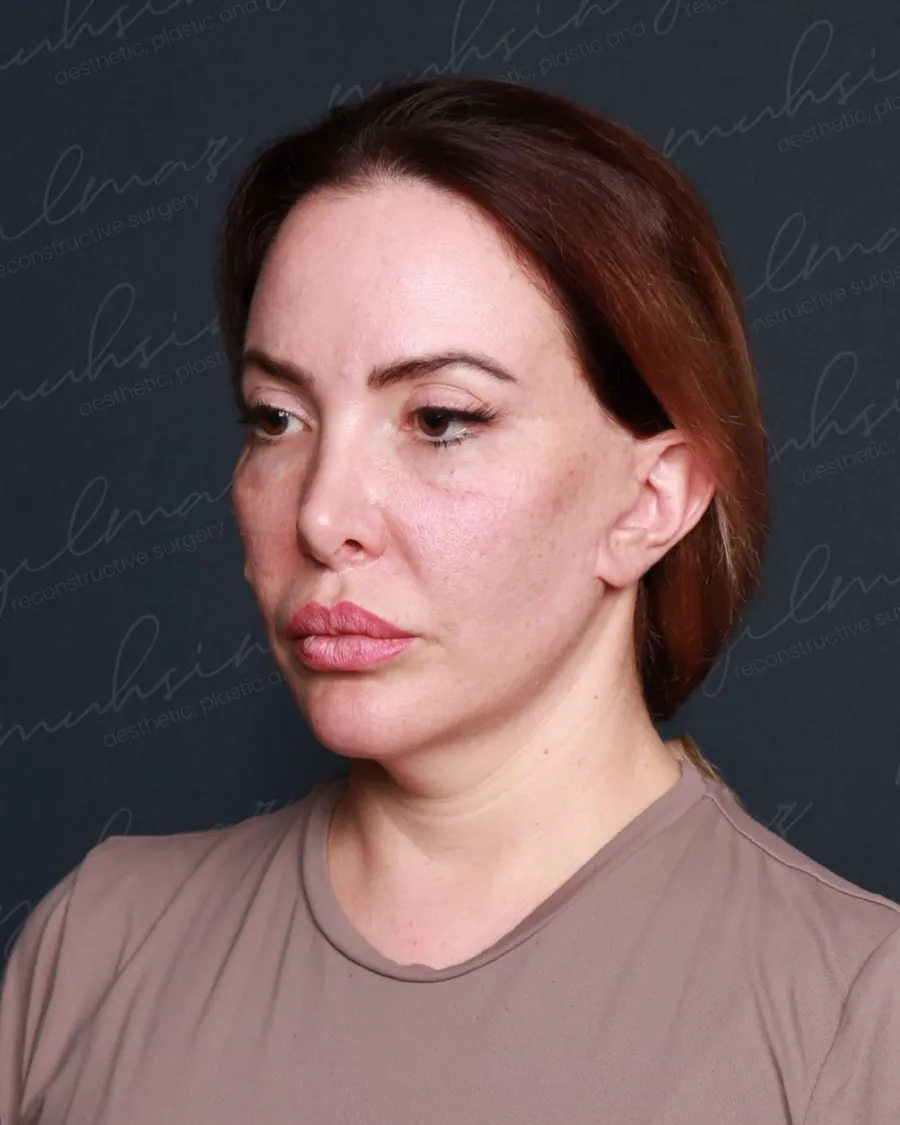


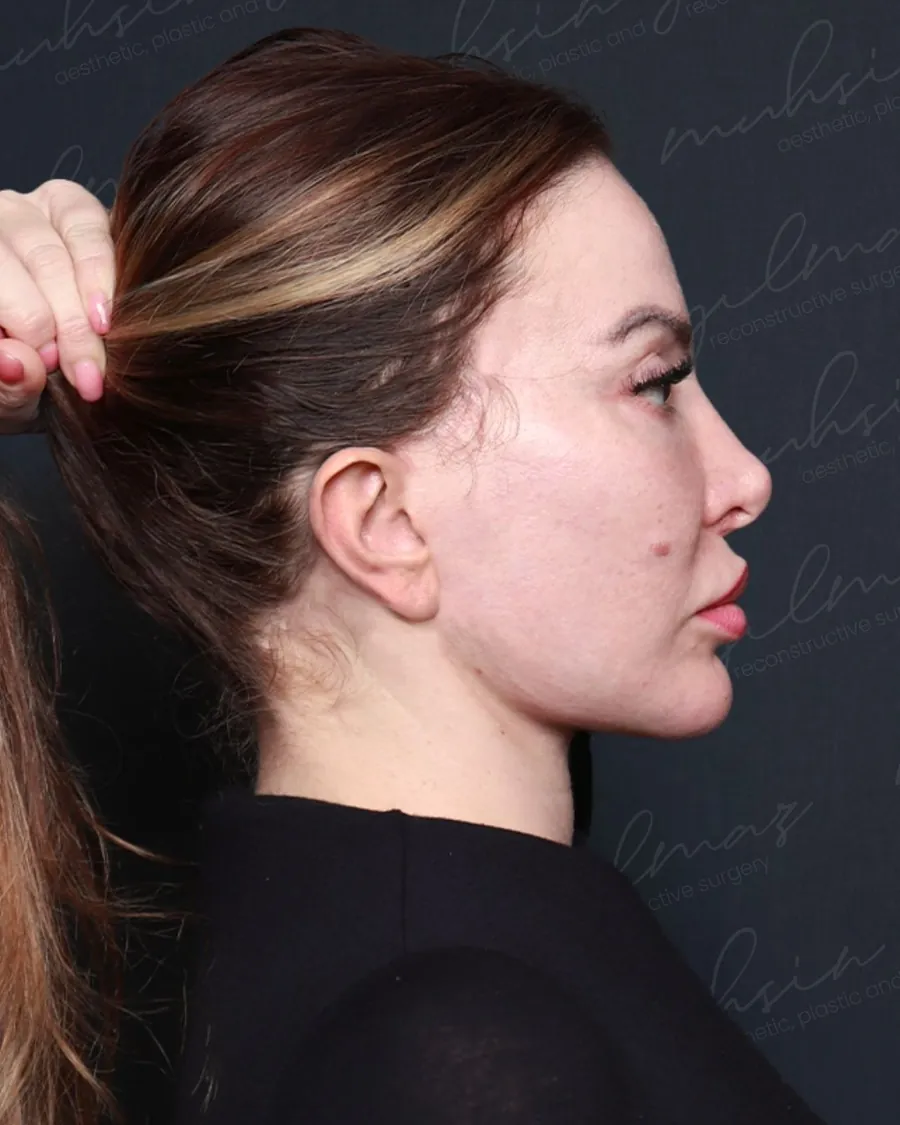


Woman, 42 · Revision extended deep plane face & neck lift + Deep neck sculpting + Temporal lift + Lower blepharoplasty
Case 15 in the gallery




Most disappointing facelift results fall into a small number of recognisable patterns: early relapse of the jowls and neck, a tight or "windswept" look, visible scars, a pulled-down or "pixie" earlobe, and distortion of the sideburn and hairline. Naming which of these applies to you is the first step of any revision plan.
Almost all trace back to the same origin: the previous operation tightened skin instead of releasing and repositioning the deeper structures of the face. Skin is not a load-bearing tissue. When it is asked to hold the lift, it stretches — the result relapses — or it is pulled too hard, and the face looks operated rather than younger.
Revision facelift surgery is a different discipline from primary surgery, because the anatomy has been altered. The natural tissue planes are scarred, the skin reserve is smaller, and the facial nerve branches no longer sit in entirely predictable positions. A revision is therefore planned around what your tissues look like now — not around what the first operation was supposed to do.
My approach is to return the face to structural surgery. In the deep plane, I release the retaining ligaments and reposition the SMAS and platysma as a unit, carrying the repair into tissue the first operation usually never reached. This is what allows a relapsed or pulled result to be corrected without adding more skin tension — and it is why a well-planned revision looks natural rather than tighter.
I do not operate on a healing face. Swelling, scar remodelling and tissue softening continue for many months after a facelift, and a result that looks alarming at three months can settle into an acceptable one by twelve. Operating too early means dissecting through immature scar, with higher risk and less predictable results.
In practice this means I plan revision surgery only after the tissues have fully settled — usually six to twelve months after the previous operation, occasionally longer. If you contact me earlier, I will assess your photographs and set a sensible date rather than a fast one.
Every photograph below is an unretouched patient of mine, shown with her written consent. Revision cases are judged the same way primary cases are: a natural result, and ears and a hairline that show no sign of surgery.
Case 15 in the gallery


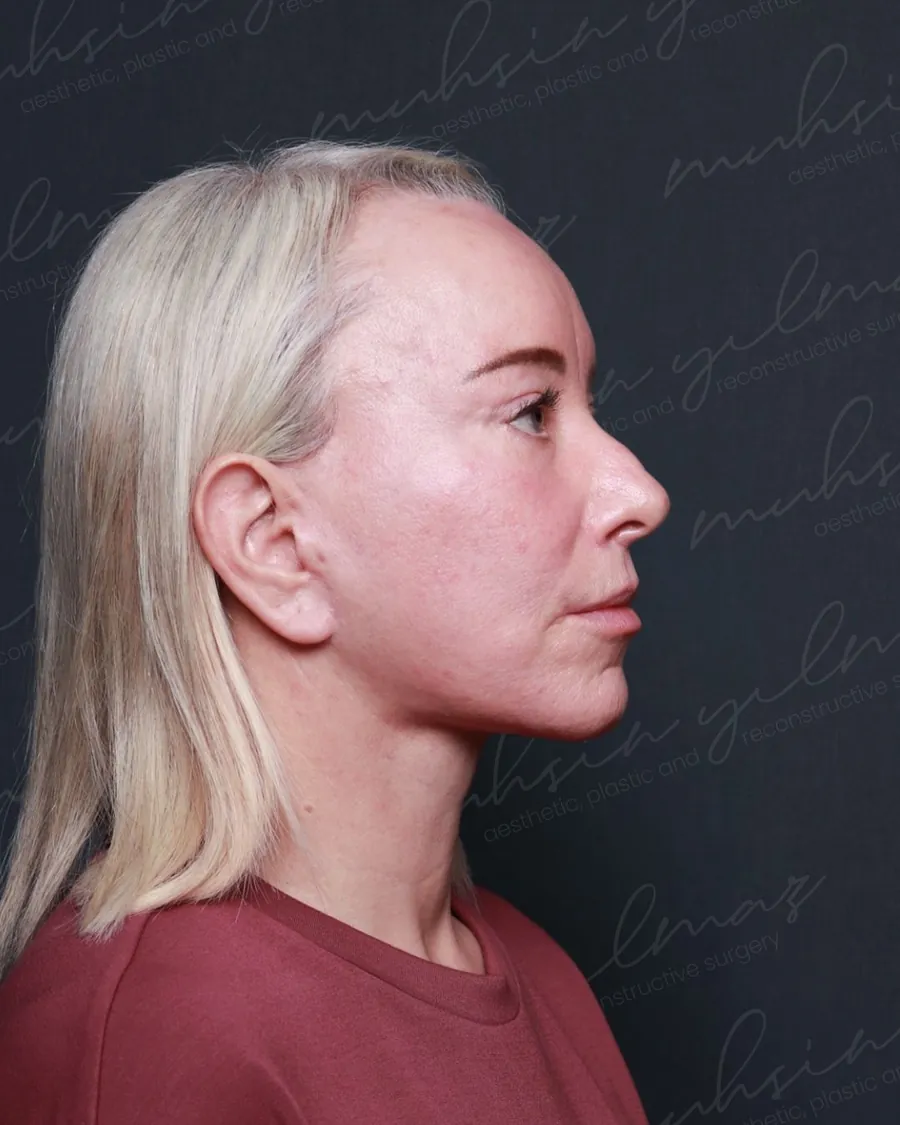


Case 04 in the gallery
Most of my revision patients had their first operation with another surgeon, often in another country. That is a normal situation, not an awkward one — and my assessment is of your anatomy, not of your previous surgeon. Techniques differ, tissues differ, and a result that disappointed you does not require anyone to be blamed before it can be corrected.
What helps me plan: your photographs from before the first operation, the operative notes if you can obtain them, and an honest account of what bothers you. If the notes are unavailable, the examination and your photographs are almost always enough.
A revision facelift differs from a first facelift in planning, dissection and goals — not simply in being "done again".
| Aspect | Primary facelift | Revision facelift |
|---|---|---|
| Tissue planes | Natural, predictable | Scarred; dissection is slower and more deliberate |
| Facial nerve | Standard anatomical landmarks | Landmarks altered; wider safety margins |
| Skin reserve | Full | Reduced — tension on skin is avoided entirely |
| Planning | Based on ageing pattern | Based on what the previous surgery did and left behind |
| Operating time | 4–6 hours | About 6 hours |
| Goal | Rejuvenation | Correction first, rejuvenation second |
A good revision candidate has a definable, correctable problem; tissues that have fully settled since the previous operation; good general health; and expectations that match what surgery can deliver. If your concern can be named — relapse, a pulled look, a visible scar, a distorted earlobe — it can usually be planned for.
I do not operate on everyone who asks. I decline revision surgery when the tissues are still healing, when the visible problem is too minor to justify an operation, when smoking or a medical condition makes healing unsafe, and when the expectation is perfection rather than improvement. Saying no in these situations protects patients — a second disappointing result is far harder to correct than a first one.
Revision facelift surgery takes place under general anaesthesia in a fully equipped hospital in Istanbul, with an anaesthesia team present throughout. I perform around 150 facelift operations per year, and revision cases are booked with longer operating slots, because scarred planes are dissected more slowly and deliberately than natural ones.
The operation itself is tailored to what needs correcting: the old scars are usually excised and repositioned, the deep plane is re-entered and the SMAS and platysma repositioned structurally, the earlobe and hairline are restored where they were distorted, and the skin is redraped without tension. Protecting the facial nerve is the central technical discipline of revision surgery, and it is the reason this operation belongs in experienced hands.
Plan roughly twelve days in Istanbul. You arrive one or two days before surgery for consultation and preoperative tests, spend the operative night — and usually a second night — in hospital, and then recover at your hotel with scheduled follow-up visits at the clinic. Sutures are removed in stages during the first week.
Swelling and bruising behave much as they do after a primary facelift, and most patients are socially presentable within two to three weeks. Before you fly home I examine you personally and confirm you are fit to travel; after that, follow-up continues over photographs and video calls. The full day-by-day timeline is in my facelift recovery guide.
Revision surgery carries the same categories of risk as primary facelift surgery — haematoma, temporary weakness of a facial nerve branch, contour irregularity, delayed skin healing and visible scarring — and operating in scarred planes raises the technical demand of avoiding them. Published series show that in experienced hands, secondary rhytidectomy achieves complication rates comparable to primary surgery.
I reduce these risks the same way I reduce them in primary surgery, with the margins widened: meticulous dissection under direct vision, strict blood-pressure control around the operation, no skin tension at closure, and an honest preoperative assessment that excludes patients whose tissues are not ready. When a problem does occur, it is managed immediately and openly — that, too, is part of the plan.
A structural revision behaves like a well-executed primary deep plane facelift: because the lift is carried by the SMAS and platysma rather than by skin, the repositioned tissues age with you at their new, corrected position. You will continue to age — no operation stops that — but the specific problem that was corrected does not simply return.
This is the practical difference between a revision that re-tightens skin and one that rebuilds structure. The first buys time; the second changes the starting point from which your face ages.
No two revision facelifts have the same scope, so no honest surgeon quotes a single price before examining you. The cost is determined by what the correction requires: the length and complexity of the operation, the hospital and anaesthesia fees, the nights spent in hospital, and the follow-up plan for an international patient.
After I review your photographs and history, you receive an itemised quote covering the operation, hospital stay and follow-up — with no hidden items added later. For how facelift pricing works in Istanbul more broadly, see the facelift cost guide.
In most cases, yes. Relapsed jowls, a pulled or unnatural look, visible scars and earlobe distortion all have recognised surgical corrections. The honest limits are set by your skin reserve and the scarring left by the previous operation — which is why revision planning starts with an examination, not a promise.
Until the tissues have fully settled — usually six to twelve months, occasionally longer. Swelling and scar remodelling continue for many months, and operating through immature scar raises risk without improving the result.
There is no fixed price, because no two revisions have the same scope. The cost depends on the complexity of the correction, operating time, hospital and anaesthesia fees, and your follow-up plan. After reviewing your photographs you receive an itemised quote; revision surgery is priced on the operating time and the complexity the scarred tissue actually demands.
Yes — most of my revision patients are in exactly this situation. I assess your current anatomy from photographs and examination. Where you had the first operation matters far less than what your tissues look like now.
Technically yes, but it is the favourable kind: a secondary facelift on a face that has aged normally, rather than a correction of a surgical problem. Planning is closer to a primary operation, though the scarred planes still demand the same careful technique.
Usually, yes. The windswept look is the signature of a skin-tension lift, and its correction is structural: releasing the scarred pull, repositioning the deep tissues in a natural vector, and letting the skin sit without tension. Fat grafting often plays a supporting role where earlier surgery has left the face hollow.
Both are among the most common — and most correctable — revision requests. Widened or misplaced scars are excised and closed without tension, and a “pixie” earlobe is released and reset into its natural position. These corrections are sometimes performed alone, without a full revision lift.
The risk categories are the same, but the operation is technically more demanding: scarred planes, altered nerve landmarks and less skin reserve narrow the margins. Published series show experienced surgeons achieve complication rates comparable to primary surgery — which is why the choice of surgeon matters more for a revision than for any first operation.
Look for a surgeon who operates on the deep structures rather than the skin, performs facial surgery at high volume, shows unretouched revision results, and is willing to tell you no. Ask specifically how many revision cases they treat, and be cautious of anyone who quotes a price or promises an outcome before examining you.
If a previous facelift has left you disappointed, the useful first step is an honest assessment of what can still be corrected. Send me your photographs and a short account of your history, and I will tell you what I would do — or whether I would advise waiting. You can share your photographs over WhatsApp, or simply send the form — the patient coordination team will request them from you afterwards.
Request a personal review See before & after results
Every enquiry is reviewed personally by Dr. Yilmaz; scheduling is handled by the patient coordination team.
Written and medically reviewed by Muhsin Yilmaz, MD, FEBOPRAS — Plastic, Reconstructive and Aesthetic Surgeon. Last medically reviewed: September 2026.
Dr. Muhsin Yilmaz is a double board-certified plastic surgeon, holding the FEBOPRAS diploma of the European Board of Plastic, Reconstructive and Aesthetic Surgery and the certification of the Turkish Board of Plastic, Reconstructive and Aesthetic Surgery, and practises in Istanbul, Türkiye. His practice is focused on facial and neck rejuvenation, centred on the deep plane facelift — around 150 facelift operations per year, performed at Acıbadem Kartal Hospital. He is a member of TSPRAS and ISAPS, and is registered with the Turkish Ministry of Health for international health tourism. Read his full profile.